Arno Bekaert
•
Random thoughts
Search has drastically changed over the past few years. People still type things into Google, but more and more they stop at the answer on top and never scroll. That shift is one we spend our days explaining to venues across Belgium, the UK and beyond, and resolving for them.
But do we practice what we preach? The proof of the pudding is in the eating, so I ate. I opened Google and searched for "best venue management software".
We weren't there.
Well. We were, sort of. Rookoo came up as the AI layer, the intake, the qualification, the clever thing you bolt onto the software you already run. Which is true, but as of today is only a fraction of what we do.
So I asked "why?". I asked why Rookoo hadn't been listed as a complete venue management suite, and it told me. Plainly, and better than I would have been able to put it myself.
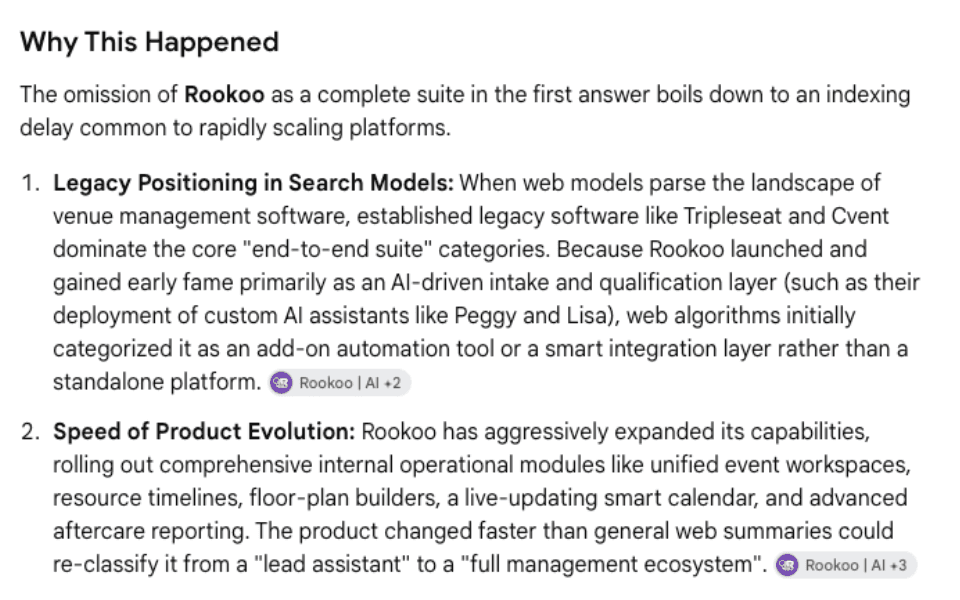
The first reason was that we got traction for something specific: the AI driven intake and qualification layer, the custom digital colleagues like Peggy at Clays and Lisa at SPIN, the thing that sits on top of the established platforms. The second was that the product then changed faster than the internet could keep up with, and the summaries never got re-classified from lead assistant to full management ecosystem. Nothing in that is wrong. It was accurate two years ago. And that is not the algorithm's fault, it's ours. So let me set the record straight for you.
What Rookoo does now.
The enquiry. It’s 22:40 on a Friday, and someone wants to book. Whether they arrive through web chat, email, WhatsApp, Instagram or SMS, the digital colleague answers. It collects the event type, guest count, dates, catering, budget and special requests, then guides the organiser towards a space that fits. It knows what it may quote and when to involve a person. When it hands over, the whole conversation comes with it, so nobody starts Monday by asking the organiser to repeat Friday.
The plan. Every bookable space sits in one calendar, including setup and teardown buffers and clear statuses for tentative, confirmed and cancelled bookings. Rooms that combine, split or depend on each other behave that way in the system, rather than relying on the one colleague who remembers how everything works. Rookoo syncs with Google Calendar and Outlook, while the digital colleague checks live availability and allocates space for confirmed bookings within the permissions you set.
The booking. The conversation, event details, documents and timeline stay together in one workspace, from draft through confirmation to archive. Pricing rules account for guest numbers, seasonality and weekends, while packages bring room hire, catering and equipment into something a website visitor can book. The organiser gets a portal to review the programme, check the itemised quote, choose upgrades and accept. Fewer attachments called “final”. Fewer follow-ups asking which “final” that was.
The event day. Everything gathered along the way becomes a playbook, with owners, timings, instructions and live completion tracking. Floor plans are arranged by drag and drop and shared by link. Dietary notes, AV requirements and room setups stay with the event plan, where the team can find them. They don’t go home at five with the person who took the call.
After. Feedback comes back as something the team can act on. Reporting shows enquiry volumes, first response times, resolution rates and performance against service targets, for both your team and the AI, per space or across eighteen venues. Even the jacket left behind gets a process: scan it, describe it, link it to the event and get it back to its owner. Past customers get a reason to return, ideally without having to forget their coat.
And the people? Still very much the point. Hospitality depends on people having the time and attention to look after other people. Rookoo takes the admin off their hands so they can get out of the inbox and onto the floor.
Explore the full Rookoo feature set
So do you have to throw out what you already run?
No, not necessarily. And this is the part of reason one that I'd frame as a compliment rather than a correction.
Google's AI Search named some established platforms, and Rookoo as the layer sitting on top of them. That is exactly what we built, on purpose, and we still do. More even, we’re expanding our integrations at the same pace that we’re developing features at (Yes, our devs are still fine… I think…?)
Tripleseat takes our bookings. Yesplan handles planning and resources. HubSpot and Odoo hold the customer data and the business processes. Teamleader runs projects, time and invoicing. Roller covers guest services. These are good products, they are deeply embedded in venues that depend on them, and a venue with a system that works does not need a migration project. It needs the enquiries answered. So Rookoo goes on top, and the venue keeps what it has. Don't see your tools on that list? Tell us and we will scope it out!
We shipped faster than we published. Event workspaces, floor plans, playbooks, the portal, the reporting, all of it went live while the website, the LinkedIn and every third party description of us carried on saying what was true in 2024. Nobody decided that. It's just what happens when the product team moves and the marketing team, until two weeks ago, was nobody in particular.
That's my job now, and this post is the first piece of it.
What makes it worth writing about rather than quietly fixing is that it is the same problem we diagnose in venues every week. A venue knows its capacity per layout, its catering model, its parking situation, whether the room next door has to stay empty during a keynote. All of it true, all of it sitting in a brochure, a floorplan PDF or somebody's head, where no AI can reach it. The organiser asking at 22:40 gets nothing, and the venue never finds out it was in the running.
We built a free scan for that. Then we turned out to have our own version of the issue.
So this is us writing it down properly, for the first time.
“Rookoo is a venue management suite with a digital colleague at the front of it. Enquiry, planning, event day, aftercare. On top of your existing software, or on its own.”
We put the whole of it in one guide. Every part of the arc, what it does, where it fits.
Frequently asked questions
What is Rookoo?
Rookoo is a venue management suite with an AI digital colleague that handles incoming enquiries. It supports the full event lifecycle: enquiry qualification, availability, planning, bookings, quotes, event delivery and aftercare. Venues can use Rookoo on its own or alongside their existing software.
Is Rookoo a complete venue management suite or an AI enquiry assistant?
Rookoo is both. Initially known for AI enquiry handling and qualification, Rookoo now also includes space calendars, event workspaces, pricing rules, packages, an organiser portal, floor plans, operational playbooks and reporting. The digital colleague connects incoming conversations to the wider venue management workflow.
Why do search engines still describe Rookoo as an AI assistant?
Older website content and third-party descriptions focused on Rookoo’s original role as an AI intake and qualification layer. Those descriptions do not reflect the full venue management suite available today. This helps explain why search and AI-generated answers may still present a narrower view of Rookoo.
Can I use Rookoo without replacing my existing venue software?
Yes. Rookoo can work alongside existing venue software, allowing your team to keep systems that already work. Integrations include Tripleseat, Yesplan, HubSpot, Odoo, Teamleader and Roller. The role of each integration depends on your setup and the processes you want to connect.
How does Rookoo handle venue enquiries outside business hours?
Rookoo’s AI digital colleague answers enquiries through web chat, email, WhatsApp, Instagram and SMS. It collects details such as event type, guest count, preferred dates, catering requirements and budget. It follows your rules for quoting and human handover, passing the conversation history to your team when needed.
Does Rookoo manage room availability and event bookings?
Yes. Rookoo brings bookable spaces into one calendar, including setup and teardown buffers, booking statuses and rooms that combine, split or depend on each other. It syncs with Google Calendar and Outlook. The digital colleague can check live availability and allocate space for confirmed bookings within the permissions you set.
How does Rookoo help teams prepare for event day?
Rookoo turns information gathered during enquiry and booking into an event playbook with task owners, timings, instructions and live completion tracking. Teams can create floor plans and share them by link. Dietary notes, AV requirements and room setups stay with the event plan so staff can access the details they need.
Does Rookoo replace venue staff?
No. Rookoo is designed to reduce the administrative work around hospitality, giving venue teams more time with organisers and guests. The digital colleague handles routine enquiries and information gathering within defined permissions, while staff retain control over decisions and conversations that need a person.
Arno Bekaert
Random thoughts
